
Bring outsourced payment infrastructure in‑house
Reduce dependency on third-party providers by insourcing core gateway capabilities and gaining more commercial and operational control.
- Own configuration, data and workflows
- Cloud or on-premises deployment
- More flexibility and stronger unit economics




The challenge
When the gateway belongs to a third party, so do your roadmap, your data and a share of every transaction.
- Per-transaction fees to the provider grow with your volumes
- Routing, pricing and new features wait on the provider's roadmap
- Transaction and merchant data sit in someone else's environment
- Switching acquirers or adding methods depends on what the provider supports
The FinOn solution
With FinOn's White-Label Payment Gateway, the gateway runs under your brand and your control, in the cloud or on your own premises.
- Own configuration, data and workflows: routing, tariffs and risk rules set by your team
- Cloud or on-premises deployment, in the environment your compliance team approves
- More flexibility and stronger unit economics: connect acquirers directly
- Merchant portal, billing and settlement on the same platform
Your rules, your data, your providers
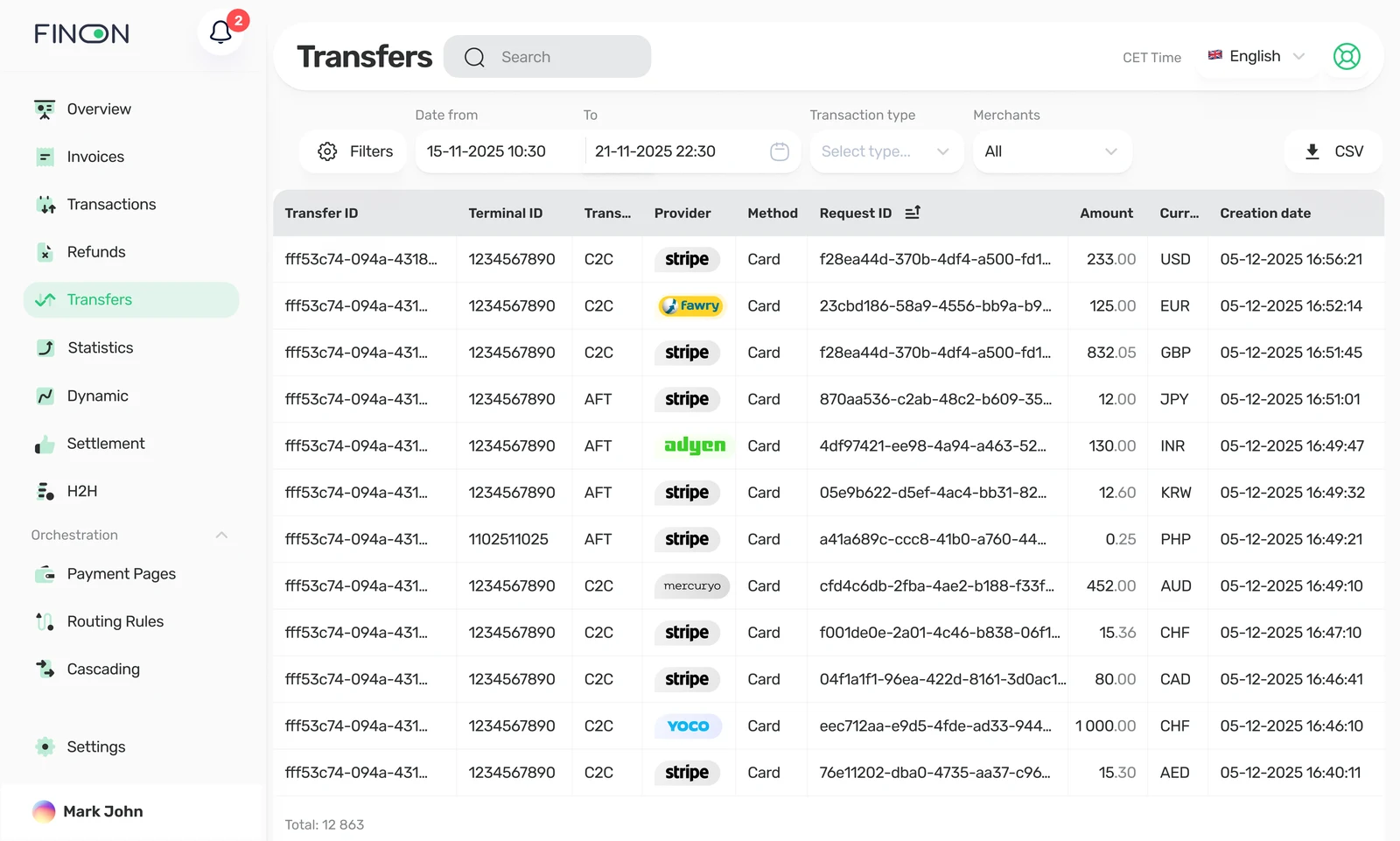
Everything that sat with your provider is now configured and visible in your own portal.
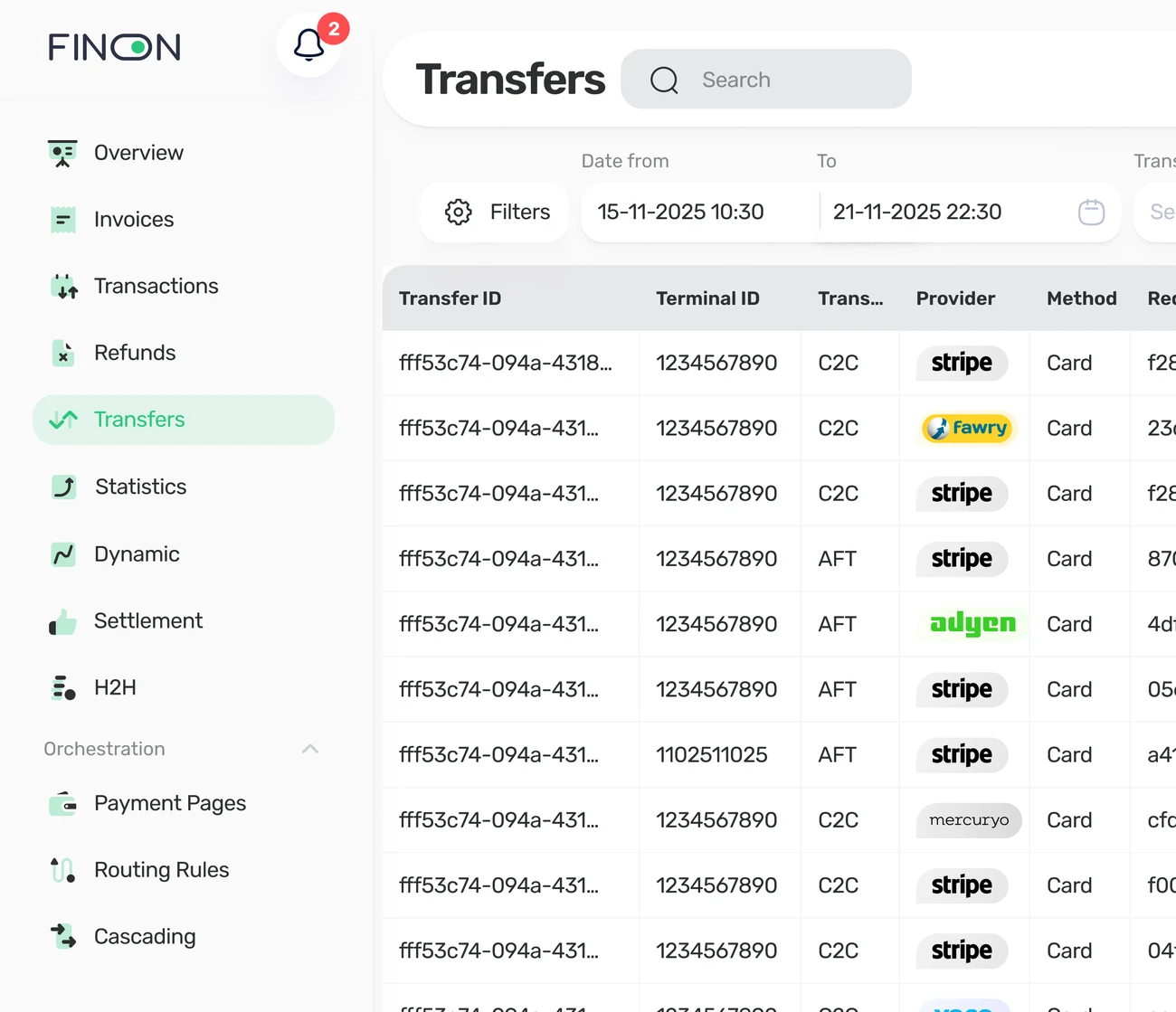
 1
2
3
FinOn portal, demo data
- 1
Your data, exportable
Search every payment by ID, date, type or merchant and export to CSV. Nothing is locked in a provider's dashboard.
- 2
Your providers
Each payment shows which provider and terminal processed it, so you can connect acquirers directly and compare them.
- 3
Your routing rules
Routing rules and cascading sit in your own portal, managed by your team.
How PSPs move payments in-house
A staged move, so merchants keep processing while you take control.
- 01
Assessment
We review your current provider setup, contracts, volumes and merchant base, and agree the target deployment and migration plan.
- 02
Deployment and integration
The FinOn platform is deployed in your cloud or data centre and connected directly to your acquirers. Routing, tariffs and risk rules are configured.
- 03
Merchant migration plan
Merchant configurations are moved, and card tokens and recurring payments are planned together with your current provider.
- 04
Parallel run
Selected merchants process through your new stack while the current provider keeps running for the rest.
- 05
Cutover and exit
Remaining traffic moves in stages, and the third-party contract is wound down once the agreed criteria are met.
Why PSPs choose FinOn to insource payments
Own configuration, data and workflows
Routing, pricing, risk rules and branding are managed by your team in your portal.
Cloud or on-premises deployment
Run the platform in your own data centre or cloud to meet data-residency requirements.
More flexibility and stronger unit economics
Connect acquirers directly and set your own tariffs and settlement cycles.
Multi-acquirer routing with failover
Primary and secondary routes, availability checks and automatic failover.
What moves in-house, and what FinOn still provides
You take control of the platform. FinOn keeps it current and supported.
Moves in-house
- Gateway configuration and routing rules
- Transaction and merchant data
- Pricing, tariffs and settlement cycles
- Risk rules, limits and white / black lists
- Branding, checkout and merchant portal
Where it runs
- Your own data centre, on premises
- Or your cloud environment
- Horizontal scaling, load balancing and active-active clusters
FinOn still provides
- Platform licence and updates
- Support under the agreed terms
- Certified platform: PCI DSS and EMVCo-approved 3DS components
Frequently asked questions
Answers to the questions PSPs typically ask before moving payments in-house.
Ownership and control
What exactly do we own?
Your configuration, routing and risk rules, pricing and tariffs, transaction and merchant data, and the branding of the checkout and merchant portal. With on-premises deployment the infrastructure is yours too. Licence terms are set in the contract.
Can we run the platform in our own data centre?
Yes. The gateway runs in the cloud or on premises, with horizontal scaling, load balancing and active-active clusters.
Can we connect acquirers directly?
Yes. You connect acquirers and processors directly and route payments between them with failover.
How does this improve unit economics?
You stop paying a provider margin on every transaction and set your own tariffs. The impact depends on your volumes and current contract terms.
Migration and commercial
How do we move off our current provider without disruption?
In stages. A pilot group of merchants moves first while the current provider keeps processing the rest, and remaining traffic follows once volumes on FinOn are stable.
What happens to card tokens and recurring payments?
They are part of the migration plan and are agreed with your current provider, as token portability depends on its terms.
Will our merchants need to change their integration?
Merchants connect to your gateway's APIs under your brand. The migration plan covers how and when each merchant switches.
What are the commercial and hosting options?
These are separate choices. Commercial model: a software licence or a managed service. Hosting: your own data centre or the cloud. Pricing depends on the modules you need and transaction volumes, and is agreed after a discovery call.
Find the right solution for your PSP.
Tell us about your current provider setup. We'll help map what to bring in-house and how to move safely.
More use cases for PSPs
Launch merchant acquiring faster
Accelerate time to market with a ready software stack for payment acceptance, merchant onboarding and day-to-day operations.
View use case 3DS ServerMigrate 3D Secure Server in-house
Bring 3DS capabilities under your control with FinOn's flexible deployment options for acquirers and PSPs.
View use case Back OfficeAutomate payment operations and reconciliation
Streamline daily payment operations with centralised workflows, reporting and financial visibility.
View use caseExplore more insights

White-Label Payment Gateway RFP Checklist: How to Choose a Vendor
A copy-ready RFP checklist for PSPs, acquirers and banks comparing white-label payment gateway vendo...

