FinOn
Back Office
Advance fee & commission calculation
Automate reconciliation
Faster settlements & reporting

Improve operational efficiency
Automate and streamline billing, clearing, and settlement processes
Transactions are automatically matched across gateway, acquiring, and clearing reports, eliminating manual reconciliation and reducing settlement errors and delays.
Merchant fees, commissions, rolling reserves, and product charges are calculated automatically using configurable pricing rules, ensuring accurate and consistent billing at scale.
A unified back-office replaces fragmented tools, giving operations and finance teams real-time visibility into transactions, balances, and settlements while significantly reducing manual workload.
Key features

Payment Processing Management
Import data directly from payment gateways, processors, and payment systems for further processing.

Flexible Tariff Engine
Configure multi-level commission schemes by transaction type, amount, currency, or partner.
Reconciliation Engine
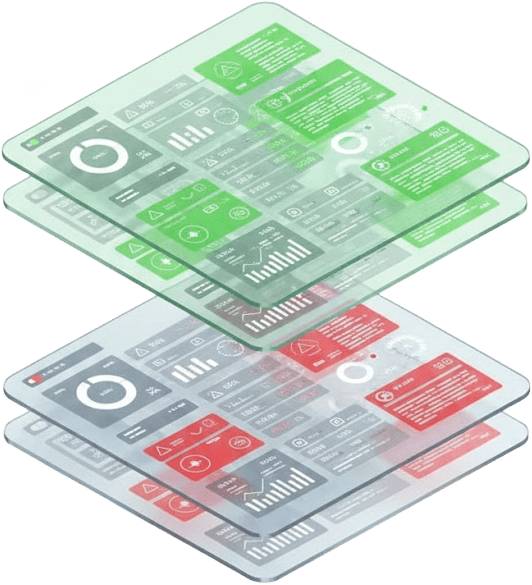
Compare transaction and registry data to detect discrepancies and reduce risks.

Settlements and Payouts
Automatically create and send settlement/payment orders to accounting or banking systems.
And other features

Advanced Analytics
Interactive dashboards and reports to visualize commissions, settlements, and profitability.

Liquidity Monitoring
Track balances in real time with alerts and control mechanisms.

Custom Reporting
Generate custom accounting, management, and regulatory reports in required formats.
Built for
Banks & Financial Institutions
Manual fees, slow matching, and delayed payouts reduce operational control and raise business cost.
- Automated fee & commission calculation
- Real-time reconciliation
- Faster settlements and reporting
PSPs (Payment Service Providers)
Scaling merchants increases business load and cost across fees and payouts.
- Scalable processing automation
- Flexible commission models
- Accelerated settlements
Payment Orchestrators
Fragmented financial data across PSPs and acquirers slows decision-making.
- Unified fee & commission engine
- Centralized processing reconciliation across multiple PSPs and Acquirers
- Consolidated reporting in real time
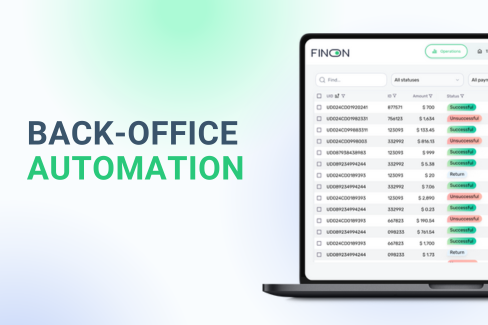
Intuitive Interface
FinOn Back Office provides a clear and structured interface designed for financial operations, reconciliation, and settlement management. The platform enables teams to efficiently manage transactions, fees, partners, and payouts — all from a single, unified workspace.

Why FinOn Back Office

High performance
Handle 10,000+ transactions per second with proven microservices reliability.

Experienced team
20+ years of global payment expertise

Seamless Integrations
Connect with payment gateways, processors, core banking, and ERP systems via open APIs and secure channels.

Fast Deployment
Launch rapidly with turnkey or tailored implementation requiring minimal IT effort.
Frequently Asked Questions
FinOn Back Office supports integration with a wide range of systems, including payment gateways, acquiring banks, core banking systems, and ERP software. Data can be imported via API, SFTP, or file upload, supporting formats such as ISO 20022, MT940, and custom JSON/CSV. Real-time and batch modes are available to fit any workflow.
Absolutely. The solution supports multi-currency payouts, FX conversion, and country-specific settlement rules making it ideal for cross-border operations.
An acquiring back-office system is designed to manage the full commercial and operational lifecycle of merchants, transactions, fees, settlements, and reporting. It enables financial institutions, processors, and payment platforms to configure pricing, calculate commissions (MDR), manage hierarchies,and automate the end-to-end payment process, cutting operating cost.
The back-office supports highly configurable MDR calculation engines, including:
- Fixed percentage rates
- Fixed amount per transaction
- Combined (percentage + fixed fee)
- Tiered pricing (volume-based thresholds)
- Interchange++ model
- Blended rates
- Card brand–specific rates
- Country-based differentiation
- MCC-based pricing
- Product-based (debit/credit/commercial)
- Installment-specific MDR
- Cross-border vs domestic differentiation
Rules can be stacked, prioritized, and overridden at merchant, group, or portfolio level.
Yes. The system supports multi-party fee distribution, including:
- Acquirer margin
- Processor fee
- Aggregator commission
- Facilitator revenue share
- Referral or partner commissions
- Platform markup
Split logic can be fixed, percentage-based, or conditional depending on transaction attributes.
Settlement configuration supports:
- T+0 / T+1 / T+N cycles (where T can be Hour-based or Day-based)
- Rolling reserve
- Deferred settlement
- Partial settlement
- Split settlement
- Multi-currency settlement
- Sub-merchant payout (PayFac model)
- Aggregator master settlement with internal redistribution
Settlement fees can be calculated independently from MDR.
Each model can be configured independently with its own hierarchy, fee rules, reporting structure, and settlement logic. The system supports multiple acquiring schemas, including:
- a) Acquirer model – direct merchant acquiring with scheme connectivity (e.g., Visa, Mastercard).
- b) Processor model – technical processing for banks or acquirers without owning the commercial relationship.
- c) Aggregator model – master merchant onboarding sub-merchants under a single MID structure.
- d) Payment Facilitator (PayFac) model – onboarding and managing sub-merchants with individual settlement logic and fee distribution.
Settlement fees can be calculated independently from MDR.
Do you have any other question?
Ready to see the Full Picture?
Let’s connect - and walk you through a personalized demo.
Explore more insights
How to Choose a White Label Payment Gateway Vendor
Selecting the right white-label payment gateway vendor is a key infrastructure decision for PSPs, ac...